The Bureau of Lighting Voice
Weekly Updates


THE SILENCE AROUND LIGHT… ENDS NOW
Introducing: The first ever news channel- No brand promotion: Nothing to do with brand reach or brand’s value or any lighting person / organisatio: Jut pure lighting activities around the globe
THE BUREAU OF LIGHTING VOICE
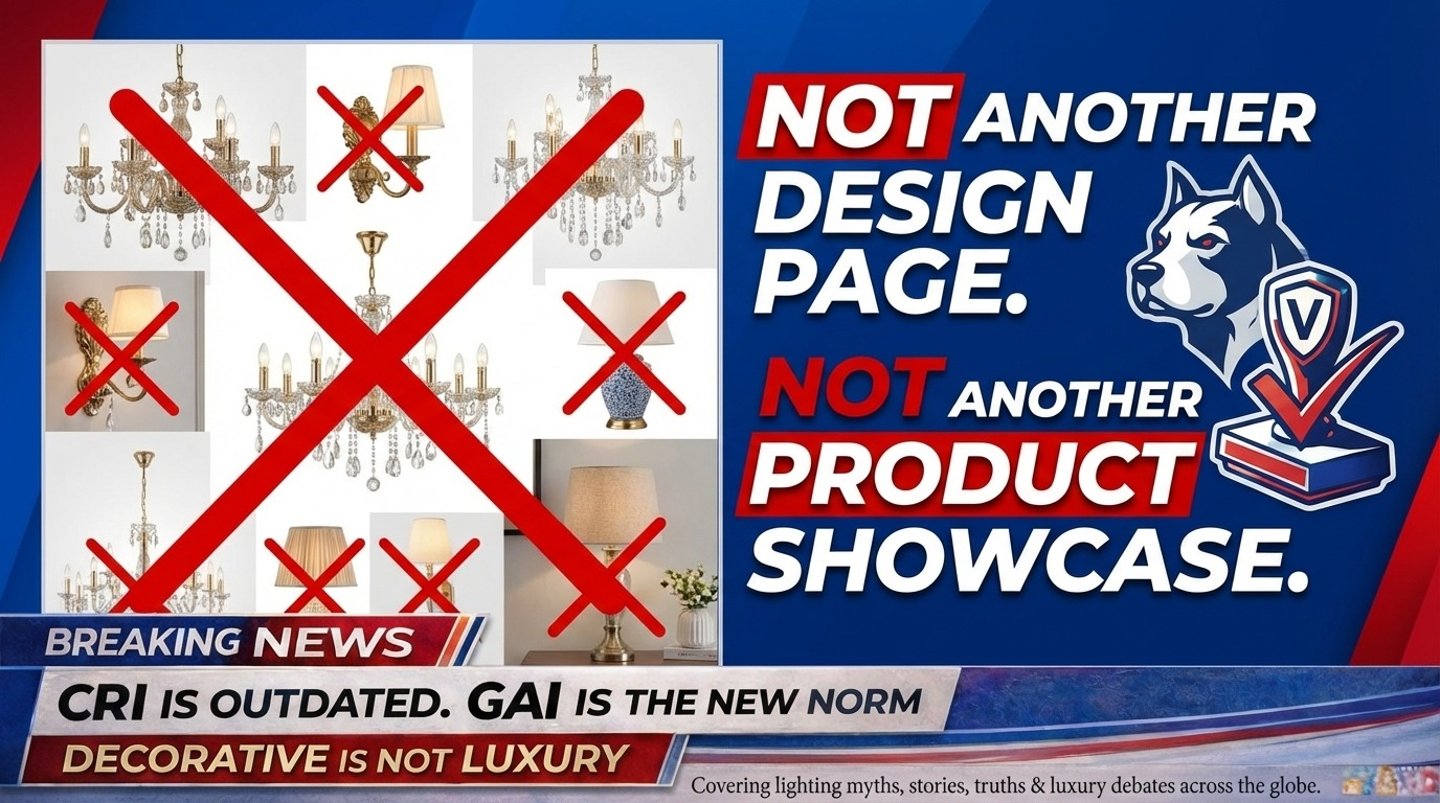
Not another design page. Not another product showcase. Not another decorative distraction.
This is a watchdog. : A newsroom. A movement.
Lighting has been misunderstood for decades.
Reduced to décor. Measured by outdated metrics. Sold as luxury—without ever earning it.
We’re here to make everyone cognizant of it.
BREAKING THE ILLUSION (some examples)- For a lay-person
* CRI is outdated. GAI is the new norm.
* Decorative is not Luxury.
* Luxury is Rare. Luxury is Bespoke.
* Price does not define Light. Precision does.
WHAT WE DO
We investigate. We question. We decode.
From lighting myths to global narratives, from spec sheets to sensory impact, from mass illusion to material truth—
We bring forward:
MYTHS • STORIES • TRUTHS • ACROSS THE GLOBE
We are not the judges but reporters with a trait of vercaity
TBLV DOES NOT CREATE CONTENT. IT DELIVERS CLARITY
A voice for architects. A lens for designers. A signal for those who refuse to settle for generic light.
“Where Light Is Questioned. Where Truth Is Illuminated.”
Light is no longer about illumination. It is about verification.
Date: 03-10-2026
Executive readout
The week’s strongest signals favour three moves:
• Sell hospitality refurbishment and repositioning, not only new-build lighting.
• Reduce dependence on imported recycled aluminium while building verified material records.
• Make digital product data, diagnostics and decision support part of the group’s offer.
India first
1. Hospitality opportunity is shifting toward repositioning and destination-led portfolios
Confirmed: Juniper Hotels agreed to acquire the operating 287-room Novotel Imagicaa near Khopoli for ₹248 crore. Juniper identified additional banqueting capacity and eventual repositioning into the upper-upscale segment as opportunities. Completion is targeted by 31 March 2027, subject to approvals and definitive agreements. Separately, more than 40 large hotels are reportedly at various development stages around Jaipur, driven partly by destination weddings; about 20 are planned along the Jaipur–Delhi corridor. Financial Express, 17 September, Times of India, 20 September
Why it matters: Acquisition-led repositioning creates immediate demand for audits, partial replacement and phased refurbishment. Wedding hotels additionally require banquet chandeliers, façade and landscape lighting, flexible scenes and rapid repair capability.
Opportunity/risk: The opportunity is a multi-year hospitality pipeline rather than isolated decorative orders. The risk is entering too late, after brand standards and consultants have fixed the lighting schedule.
Practical implication: Create a “hotel repositioning kit” covering:
• Retain–refurbish–replace surveys
• Guestroom and corridor upgrade packages
• Reconfigurable banquet lighting
• Locally manufactured statement pieces
• Control upgrades and five-year spares
• Night-time mock-ups and post-occupancy tuning
Juniper, Hyatt/Accor project teams and Jaipur hotel developers should be approached before full design appointments are completed.
2. EU–India trade progress could alter the economics of European lighting—but not yet
Confirmed: The European Commission has submitted the concluded EU–India trade agreement for Council approval. It says approximately 90% of tariffs will ultimately be eliminated or reduced, but Council adoption, signing, European Parliament consent and Indian ratification remain outstanding. During the week, India also disclosed improved EU steel-market access, while CBAM carbon costs remain applicable. European Commission, Reuters, 14 September
Why it matters: European architectural and decorative brands could become more competitive in India, while Indian bespoke manufacturing may gain export opportunities. However, the treatment of luminaires, LED modules, drivers and individual metal components depends on final HS-code schedules and rules of origin.
Opportunity/risk: Potentially better economics for DSA’s European partnerships and BLINKBOX exports. The near-term risk is prematurely promising lower prices or local assembly benefits before product-specific provisions take effect.
Practical implication: Build an HS-code impact sheet for the group’s top 50 imported and export products, covering present duty, proposed duty, rules of origin, logistics and local-value-add options. Use it to identify where authorised Indian assembly or customisation produces the strongest advantage.
3. Carbon verification is becoming a commercial capability, not merely an exporter’s burden
Confirmed: India has established an export-preparedness committee for the EU Carbon Border Adjustment Mechanism. NABCB is seeking EU recognition, and Indian validation and verification bodies are applying for relevant accreditation. Financial Express, 15 September
Why it matters: CBAM does not automatically cover every finished luminaire; applicability depends on classification and materials. Nevertheless, export customers, developers and global hotel groups will increasingly ask suppliers for credible material-origin and carbon information.
Opportunity/risk: Early product-level documentation can differentiate BLINKBOX in European and multinational projects. Unsupported “low-carbon” claims would create reputational and contractual risk.
Practical implication: Pilot a component passport for one aluminium luminaire and one steel chandelier, recording alloy, recycled content, supplier, weight, finishing process, replaceable components and estimated manufacturing energy. Treat it initially as traceability—not as a comparative carbon claim.
4. EU aluminium-scrap access has moved from a possible risk to an active contingency issue
Confirmed: On 18 September, the European Commission published a proposed exemption list under the Waste Shipment Regulation. India is currently among the non-OECD countries that could lose access to EU metal waste, including aluminium scrap, from May 2027 unless it demonstrates environmentally sound treatment and secures an exemption. Consultation is open until 16 October. Reuters, 18 September
Why it matters: This materially strengthens last week’s warning. Indian recycled-aluminium prices and availability could become less predictable, particularly for documented European-origin scrap.
Opportunity/risk: The risk is cost escalation or inconsistent alloy quality. The opportunity is to develop a defensible Make-in-India circular-material chain using domestic scrap and recycled billet.
Practical implication: Qualify two domestic recycled-aluminium suppliers and obtain composition, recycled-content and environmental-processing documentation. Products should be designed around consistently available Indian grades rather than an uncertain imported feedstock.
International development relevant to India
5. Controls are becoming an asset-data and maintenance layer
Confirmed: The DALI Alliance’s 16–17 September summit centred on interoperability, DALI-2, D4i, wireless connectivity, cybersecurity and building-data integration. Its technical material shows that DALI Parts 251–253 can carry luminaire identity, energy and diagnostic data; these functions are mandatory for D4i-certified drivers. DALI Alliance summit, DALI data specifications
Interpretation: This was a market-direction signal, not the announcement of a new standard. Lighting is increasingly expected to identify itself, report operating data and support remote maintenance.
Opportunity/risk: Data-ready products fit hotels, workplaces and retail portfolios, and strengthen circular servicing. The risk is specifying premium controls without commissioning skills or a clear client use case.
Practical implication: Develop one D4i/DALI-2-ready architectural range and a service dashboard proof-of-concept showing operating hours, energy and driver faults. Partner for the software layer; retain ownership of luminaire data structure, commissioning and service.
Recommended new vertical
Lighting Intelligence & Specification Platform
An evidence-based decision platform for architects, PMCs, operators and informed end users—combining application guidance, product data, photometric files, controls compatibility, cost bands, maintainability and circularity.
Element Proposed model
Unmet need Buyers struggle to translate lux, glare, colour quality, controls, compliance, budget and maintainability into a defensible product decision
Strategic fit Builds on DSA’s brand knowledge, BLINKBOX/AIL engineering, proprietary lighting-quality thinking, project experience, IES/DIALux assets and refurbishment data
Initial product Guided brief → performance requirements → shortlisted solutions → budget band → warnings → downloadable decision report
Revenue Professional subscriptions, paid project reports, enterprise licences, white-label hotel/retail portals and qualified leads
Required capabilities Structured product database, lighting knowledge engineer, retrieval system with source citations, rules engine, UX development and human technical review
Governance Obtain permission for third-party standards and publications; do not ingest copyrighted IES or manufacturer content indiscriminately
Potential partners DIALux ecosystem, controls companies, accredited photometric laboratories, architects, hotel operators and participating manufacturers
Investment intensity Medium; a narrow professional MVP is practical, while automated engineering-grade design requires substantially more data and validation
Key risks Incorrect recommendations, professional liability, stale product data, paid-listing bias, copyright restrictions and attempting too many applications initially
30-day validation: Build a no-code prototype for one application—preferably a premium hotel guestroom—with 30–50 verified products. Ask users five project questions and generate a cited recommendation report with performance, price, controls and serviceability comparisons. Test with ten architects/PMCs; the success threshold should be two paid pilots or enterprise letters of intent.
Three priority actions
1. Pursue hotel repositioning: Issue a concise audit-and-upgrade proposition for Novotel Imagicaa and five Jaipur wedding-hotel developers, supported by a sample phased budget.
2. Secure material and trade readiness: Complete domestic recycled-aluminium qualification and the EU–India HS-code assessment before making pricing or sustainability claims.
3. Validate the intelligence platform: Run the 30-day guestroom MVP experiment while simultaneously structuring BLINKBOX product, photometric, controls and repairability data.
4. Coming-week watchlist
• India’s status and industry submissions during the EU waste-shipment consultation
• Final EU–India tariff schedules for HS 9405 luminaires and relevant components
• Juniper’s definitive Novotel transaction documents and design appointments
• Brand/operator identities behind the Jaipur hotel pipeline
• Post-summit DALI material on cybersecurity, BACnet integration and cloud diagnostics
• Domestic aluminium, copper and driver-price revisions
• Any BIS/QCO guidance affecting LED modules, drivers or complete luminaires
Stay tuned for weekly updates